
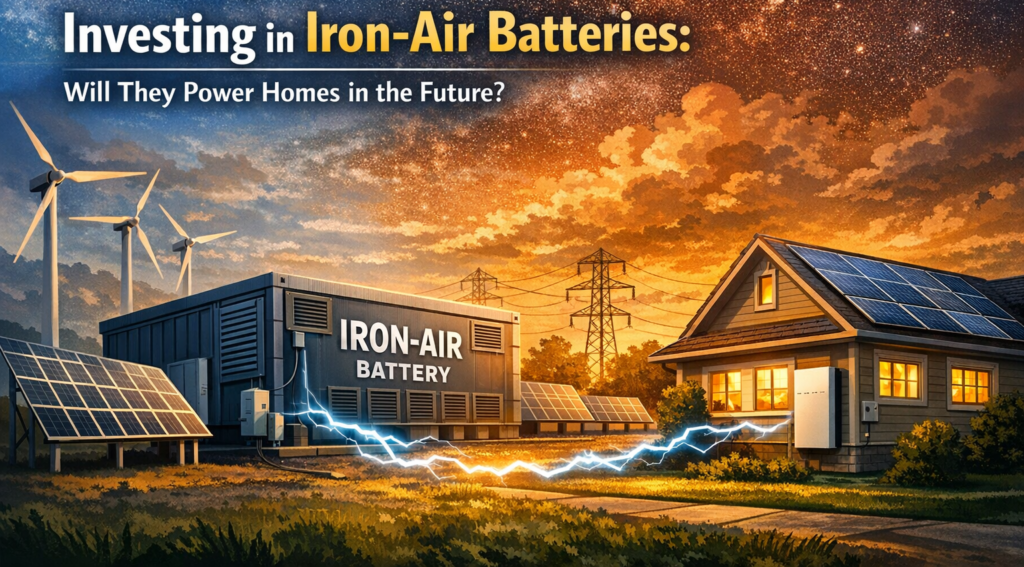
Google’s latest move into energy storage has put iron-air batteries firmly on the radar. The company is backing a major long-duration battery project in the United States using technology from Form Energy, designed to store electricity for up to 100 hours. That is a very different proposition from the lithium-ion batteries most Australians know from home battery systems such as Tesla Powerwall, Sungrow, BYD, Sigenergy, and RedEarth.
For homeowners, the obvious question is whether this new battery chemistry could eventually replace lithium batteries in garages, on rural properties, or alongside rooftop solar. The short answer is not yet. But the bigger story is still important, because iron-air batteries could change how grids store renewable energy and that may indirectly benefit households over time.
In this article, we will break down what iron-air batteries are, why Google is interested in them, how they compare with lithium batteries, and whether they are likely to turn up in Australian homes any time soon.
What are iron-air batteries?
Iron-air batteries are a type of rechargeable battery that stores and releases energy through a process often described as reversible rusting. Instead of relying on lithium-based materials, these systems use iron, oxygen from the air, and water-based chemistry to charge and discharge electricity.
When the battery discharges, the iron reacts with oxygen and slowly turns into rust. That chemical reaction releases electricity. When the battery charges, electricity is used to reverse the process, converting the rust back into iron so the battery can be used again.
That is the simple version, but the important point is this: iron is cheap, abundant, and widely available. That gives iron-air technology a very different economic profile from lithium-ion batteries, especially for large-scale energy storage.
Why the chemistry is attracting attention
Battery technology is always a trade-off. Lithium-ion batteries are compact, efficient, and excellent at fast charge and discharge. Iron-air batteries are not trying to beat lithium at that game. Instead, they are designed to deliver very long-duration storage at lower material cost.
That matters because renewable-heavy electricity systems do not just need batteries for the evening peak. They increasingly need batteries that can bridge multi-day gaps in wind and solar generation. That is where iron-air batteries start to look interesting.
Why Google is investing in iron-air batteries
Google’s investment has drawn attention because it is not a small pilot or a flashy concept demo. It is tied to a very large proposed battery project intended to support clean energy supply for a data centre load. The scale is what makes headlines, but the reason behind it is more important.
Big technology companies are under pressure to secure reliable, lower-emissions electricity as their data centre demand grows. Artificial intelligence, cloud computing, and digital infrastructure are all increasing power consumption. A standard four-hour battery can help shift solar power from the middle of the day into the evening, but it does not fully solve the problem of prolonged low-wind or low-solar periods.
That is why Google is looking at iron-air batteries. They are intended to store energy for days, not just hours. In theory, that means renewable generation can be firmed over longer weather events without relying as heavily on gas peakers or other fossil backup.
Why this matters beyond Google
Google is not investing in iron-air technology because it expects homeowners to install one beside the barbecue next month. It is investing because long-duration energy storage could become critical infrastructure for modern electricity systems.
If large users such as Google help accelerate demand and commercial deployment, the industry gains more real-world operating data, more manufacturing scale, and potentially lower costs. That tends to benefit the broader energy market over time, even if the first applications are utility-scale rather than residential.
How iron-air batteries work compared with lithium batteries
The easiest way to understand iron-air batteries is to compare them with the lithium-ion systems already dominating the battery market.
Lithium-ion batteries
Lithium-ion batteries are the current leader in home storage because they are compact, highly efficient, and respond quickly. They are well suited to storing excess rooftop solar during the day and discharging it in the evening when power prices are higher or solar production drops.
They are also good for backup power, load shifting, and virtual power plant participation. In the Australian home battery market, lithium-ion is still the standard for good reason.
Iron-air batteries
Iron-air batteries, by contrast, are not really aiming at the same use case. Their value is not compact size or instant high-power response in a household setting. Their value is long-duration storage using inexpensive materials.
That means they are more likely to be deployed in large grid-connected installations where physical footprint matters less than cost per stored kilowatt-hour over long durations.
Put simply:
- Lithium batteries are excellent for daily cycling and household energy management.
- Iron-air batteries are promising for multi-day storage on the grid.
- The two technologies are more likely to complement each other than directly compete in the near term.
What makes iron-air batteries appealing
There are several reasons the industry is paying attention to iron-air batteries.
Low-cost materials
Iron is one of the most common materials on Earth. That matters because battery cost is heavily influenced by material supply chains. Compared with lithium, nickel, and cobalt, iron offers a simpler and potentially cheaper path for large-scale deployment.
Long-duration storage
The biggest selling point is duration. While most lithium grid batteries are commonly built for two to four hours, iron-air systems are being developed for storage lasting several days. That opens up use cases that short-duration batteries struggle to handle economically.
Grid support for renewable energy
As grids take on more wind and solar, they need more flexible storage. Short-duration batteries help with frequency response and evening peaks. Long-duration batteries could help cover cloudy, windless, or stormy periods that stretch beyond one night.
What are the downsides of iron-air batteries?
This is where the hype needs a bit of adult supervision. Iron-air batteries are promising, but they are not a magic bullet.
They are not compact
One of the biggest limitations is size. These systems take up much more space than lithium batteries for the same power output. That is not a dealbreaker for utility projects, but it is not exactly ideal for a suburban garage in Brisbane.
Efficiency is lower
Iron-air systems typically have lower round-trip efficiency than lithium-ion batteries. In practical terms, more energy is lost in the charge-discharge cycle. That can be acceptable for certain long-duration grid applications, but it is a disadvantage in residential settings where efficiency matters more.
Commercial rollout is still early
Perhaps most importantly, this technology is still at an early commercial stage. It has strong potential, but it is not yet a mature, mass-market household product. There is a big difference between a major announced project and a battery technology becoming standard kit for Australian homes.
Will iron-air batteries be coming to homes soon?
For most homeowners, the honest answer is no, not soon. Iron-air batteries are far more likely to appear first in utility-scale projects, renewable energy hubs, and industrial energy applications than in residential solar-and-battery systems.
That does not mean they are irrelevant to households. It just means their impact will probably be indirect before it is direct.
Why they are unlikely to replace home batteries soon
- They are physically larger than lithium home batteries.
- They are better suited to multi-day grid storage than fast household cycling.
- They are still early in commercial deployment.
- Residential battery buyers currently value compact design, proven installer familiarity, and strong inverter compatibility.
Right now, lithium batteries still make far more sense for homes because they are purpose-built for daily solar self-consumption, blackout protection, and tariff optimisation.
Could they still affect your home energy future?
Yes, and this is the part homeowners should actually care about. Even if iron-air batteries do not end up on the wall of your garage any time soon, they could still influence your power bills and the value of home energy systems.
If long-duration grid storage scales successfully, it could help stabilise renewable-heavy electricity systems, reduce curtailment, improve reliability, and lower the need for expensive fossil fuel backup. Over time, that may create a more stable wholesale energy market and a better operating environment for rooftop solar, home batteries, and smart energy tariffs.
In other words, iron-air batteries may not be coming to your home soon, but they may still help shape the grid your home depends on.
What Australian homeowners should do right now
For Australian households thinking about energy storage today, the best move is still to focus on proven residential battery technologies. That means assessing your current electricity usage, solar size, tariff structure, backup power needs, and payback expectations.
Today’s market leaders are still lithium-based systems, and the right battery for your home depends on factors such as:
- usable capacity
- backup capability
- hybrid versus AC-coupled design
- warranty terms
- installer quality
- software and monitoring features
- price after incentives
That is why comparing multiple quotes matters. Battery pricing, installation quality, and product recommendations can vary dramatically between installers.
If you want to compare options from trusted battery installers, visit Australian Battery Quotes to review different battery systems and get a better feel for what suits your property.
Where iron-air batteries fit in the bigger battery picture
The battery market is not moving toward one winner-takes-all chemistry. It is moving toward specialisation. Lithium-ion batteries are likely to remain dominant in homes, electric vehicles, and short-duration storage for years yet. Iron-air batteries are emerging as a potential solution for long-duration, grid-scale storage where cost and duration matter more than compactness.
That is why Google’s investment is worth watching. It signals serious commercial interest in a battery category designed to solve a different energy problem. Not every new battery chemistry makes it out of the lab and into widespread use, but when companies with serious energy demand start backing a technology at scale, the market pays attention.
So, will iron-air batteries be coming to a home near you soon? Probably not in their current form. But will they matter? Absolutely. They could become a major part of the broader energy transition, helping grids absorb more renewables and making the future electricity system cleaner, more resilient, and better balanced.
For now, homeowners are still best served by comparing today’s proven battery technologies carefully. For the future, though, iron-air batteries are one of the most interesting developments on the board.